

Table of Contents
In this blog, we’ll talk about the basic difference between barcodes and QR codes. We’ll also cover their distinguishing features, types, and advantages.
The Government of India announced in 2021 that they will be using QR codes to deliver E-RUPI digital vouchers to beneficiaries1.
On a completely different side of the spectrum, news had circulated some time ago that a bar code helped police forces catch a murder culprit recently2.
Both of these statements seem quite disjointed, don’t they?
However, here is something that DOES connect them.
In both of these cases, scannable codes helped facilitate government agencies. Whether it be payments or, well, crime solving!
On the face of it, the difference between barcodes and QR codes seems indistinguishable.
In some cases, it actually is! (Exhibit A: Japan’s rMQR code3)
Nevertheless, if you look closely, you’ll see that Barcodes and QR codes are quite different. In this blog, we’ve tried to clear the air with as many examples as possible.

Difference Between Barcodes And QR Codes
A barcode helps in storing and transmitting data related to consumer products or customers. So, for instance, when customers go grocery shopping, the POS terminals scan these barcodes.
On the other hand, a QR code helps in storing and transmitting various types of information, including text, images, contacts, music, etc. Most importantly, it helps in facilitating online payments as well.
So, let’s now take a holistic look at the difference between a barcode and a QR code.
| Differentiation | Barcode | QR Code |
| Representation | A vertical arrangement of parallel lines | An arrangement of dots of various sizes on a square or rectangle grid |
| Year of Development | Developed in 1952 by Norman Joseph Woodland | Developed in 1994 by Masahiro Hara |
| Types | Ideally, it is of two types: two-dimensional codes and Three-dimensional codes | Ideally, it is of two types: two-dimensional codes and Three-dimensional codes |
| Information storage | Stores less customer-centric information compared to QR codes | Stores more customer-centric information as compared to barcodes |
| Identification uniqueness | Common for similar products. For example, every 20-gram pack of chips by a particular company will have the same barcode | Unique in nature. QR codes give a unique identifier to every asset, such as a product, a web page, or any other asset linked to it |
| Ease of scanning | Difficult to scan sometimes and have to be entered manually into the system | Easy to scan even when scanned upside-down or in a damaged state |
What Is A Barcode?
A barcode is a machine-readable label ideally consisting of a pattern of
-
- Lines of varying lengths
-
- Numeric values
-
- Alpha-numeric values
…or a combination of all.
Therefore, merchants from various industries use these coded labels to track assets and inventory throughout the entire supply chain.

Moreover, when applied with thought and planning, barcodes have proven to be excellent tools to
-
- Manage inventory costs
-
- Reduce errors
-
- Provide visibility to the supply chain
-
- Save time and effort to update inventory
Types Of Barcodes
Potentially, various industries use hundreds of different types of barcode configurations today.
However, they’re built on three standard types of barcodes:
-
- Numeric-only barcodes
-
- Alpha-numeric barcodes
-
- 2-dimensional barcodes
Numeric-only barcodes are those that consist of only numbers. Meanwhile, alpha-numeric barcodes are a combination of numbers and alphabets.
These two types of barcodes are usually categorized as one-dimensional or 1D barcodes.

Two-dimensional barcodes or 2D barcodes, are typically square or rectangular in shape. They’re made of a series of small dots arranged in a particular pattern.

Compared to 1D barcodes, 2D barcodes can hold much larger quantities of data in a smaller amount of space.
Moreover, they’re readable even when printed or inscribed on a product in a very small size.
What Is A QR Code?
QR code meaning is a Quick Response code and technically speaking, it is a form of a 2D barcode. They’re checkerboard-like scannable squares that have grown much in popularity in recent years.
Unlike a barcode, a QR code is backed by a link that, when scanned, takes the scanner to a webpage, an app, or, in many cases, a payment portal. They can also be easily scanned using a smartphone camera.
Nowadays, QR code payments are becoming a necessity for merchants accepting payments today.

Even small and medium business owners, from Kirana stores to online businesses, are starting to accept payments through QR codes.
Interestingly, QR codes can help turn Cash on Delivery orders into online payments. Thus, this can help e-commerce businesses move toward a digital-first payment ecosystem.
Advantages Of QR Codes
QR codes have come a long way from being just regular inventory management tools. Today, they’re in use across various sectors for multiple day-to-day activities.
To give you an example, many restaurants now ask customers to scan QR codes to access the restaurant’s menu and even place orders.
This helps reduce the counter line by enabling quick payments.
Meanwhile, thanks to companies like Paytm, BharatPe, PhonePe, etc., consumers can now scan QR codes at a merchant site and quickly make UPI payments against their purchases.

Other advantages of QR codes are as follows:
-
- They’re quick and error-free payments
-
- Comparatively, they enable merchants to access more customer information
-
- They can be embedded with business logos to make them recognizable and more reliable
-
- They’re also easy to generate and one can save them in the form of an image
-
- They’re readable even in a damaged state
-
- Customers can easily scan QR codes using their smartphone’s camera or any UPI app
What are the Types Of QR Codes?
QR codes can be differentiated on the basis of dimensions or their usage.
On The Basis of Dimensions
2D QR Codes
Since these are two-dimensional in nature, users usually print them on a flat surface like paper or signage.
Moreover, users can print them using a regular printer. Hence, they are convenient for both merchants and customers.
3D QR Codes
Although they look exactly like 2D QR Codes, 3D QR Codes are created using dedicated 3D printers.
Unlike 2D QR codes that have squares, 3D ones have boxes. Moreover, the latter can hold more information and usually, manufacturers or warehouses use them that need such capabilities.
On The Basis of Usage
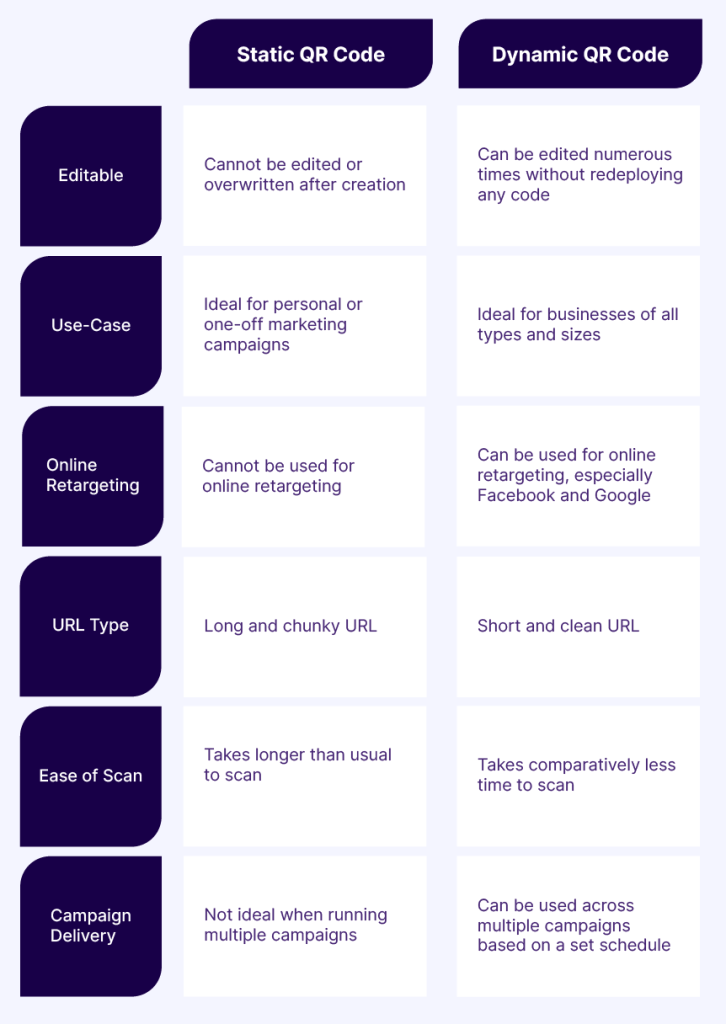
Besides the above-mentioned two types of QR codes, they can also be classified as static and dynamic QR codes.
Static QR codes
Static QR codes are a type of QR code that, once generated, contain fixed information and cannot be modified. These codes are often used for simple, one-time purposes where the encoded data doesn’t need to change. Common uses include embedding URLs, contact details, or payment information.
For payments, a static QR code typically contains a merchant’s account or payment link. Customers can scan the code with a smartphone to make a payment. However, the transaction amount and details must be manually entered by the user, as the QR code cannot dynamically adjust to different transactions.
Static QR codes are advantageous due to their simplicity and ease of creation. They don’t require an internet connection to function and can be printed on physical materials like posters, business cards, or receipts. However, they lack flexibility, as the information encoded is permanent and cannot be altered after creation.
Dynamic QR codes
Dynamic QR codes are advanced QR codes that allow for flexibility and can be updated even after they have been generated. Unlike static QR codes, which contain fixed data, dynamic QR codes store a short URL that redirects to a destination, enabling the underlying content or information to be modified without changing the QR code itself.
This makes them ideal for applications where information frequently changes, such as marketing campaigns, event details, or payment transactions. For instance, in payment systems, a dynamic QR code can automatically include the transaction amount, making the process easier for customers.
Dynamic QR codes also offer detailed analytics, allowing businesses to track scans, locations, and devices used. They can be protected with passwords, set to expire after a certain time, and customized with branding elements. Though more complex and typically requiring a subscription service, dynamic QR codes provide greater functionality and adaptability compared to static ones.
Apart from this, there are certain other differences between the two.
What Is The Difference Between A Barcode, QR Code, And RFID?
We already covered the difference between a barcode and a QR code. And now let’s understand how they differ from RFID.
RFID, or radio-frequency identification, is a unique technology that, similar to scannable codes, inscribes information in tags.
It requires a reader to access the information and complete the necessary process.
FASTag is a classic example of RFID. It utilizes the technology to make toll payments directly from the user’s prepared FASTag card to the respective authorities.
Unlike scannable code, RFID makes use of electromagnetic fields. Here’s how it works:
-
- An RFID tag contains some basic information, which could be, for instance, an inventory number
-
- An RFID reader releases some interrogation pulse in the form of radio signals and indicates the reader to read the encoded information
Barcode vs. QR Code: Which Is Better?
When we compare and talk about the difference between barcodes and QR codes, it is questionable which one is better.
Every old technology is someday replaced by a newer innovation. The same is the case with barcodes vs. QR codes.
Introduced in 1952, barcodes helped businesses streamline their inventory and other similar processes. QR codes just helped them diversify into innovative directions.
Where barcodes have been sincerely encoding simple information for merchant understanding for many decades now. QR codes are helping simplify the old, complex inventory management system into a simpler module.
In fact, with the rate at which QR codes are being innovated and used across various vertices, it’s no surprise that the usage of barcodes will, in the coming future, get restricted to certain industries and segments only.
Conclusion
Here, both barcodes and QR codes have the same purpose of storing data; QR codes can hold much more information in a smaller space. Barcodes are used for inventory management and pricing, while QR codes are used for digital transactions, marketing, and online interactions.


