> ## Documentation Index
> Fetch the complete documentation index at: https://www.cashfree.com/docs/llms.txt
> Use this file to discover all available pages before exploring further.
# Webhook Idempotency
> Handle duplicate Cashfree Payment Gateway webhook deliveries safely: deduplicate by cf_payment_id and treat only SUCCESS as terminal.
When integrating with Cashfree Payment Gateway, it's crucial to implement webhook idempotency to ensure your application processes only final and unique payment events. Below are the core principles and practices to follow.
## Key concepts
The following are the key concepts:
* **Multiple payment attempts per order\_id**: For a single `order_id`, Cashfree allows multiple payment attempts until one succeeds. Each attempt generates a unique `cf_payment_id`.
* **Unique payment\_id per attempt**: Every retry—whether triggered by the user or automatically—will have a distinct `cf_payment_id` but the same `order_id`.
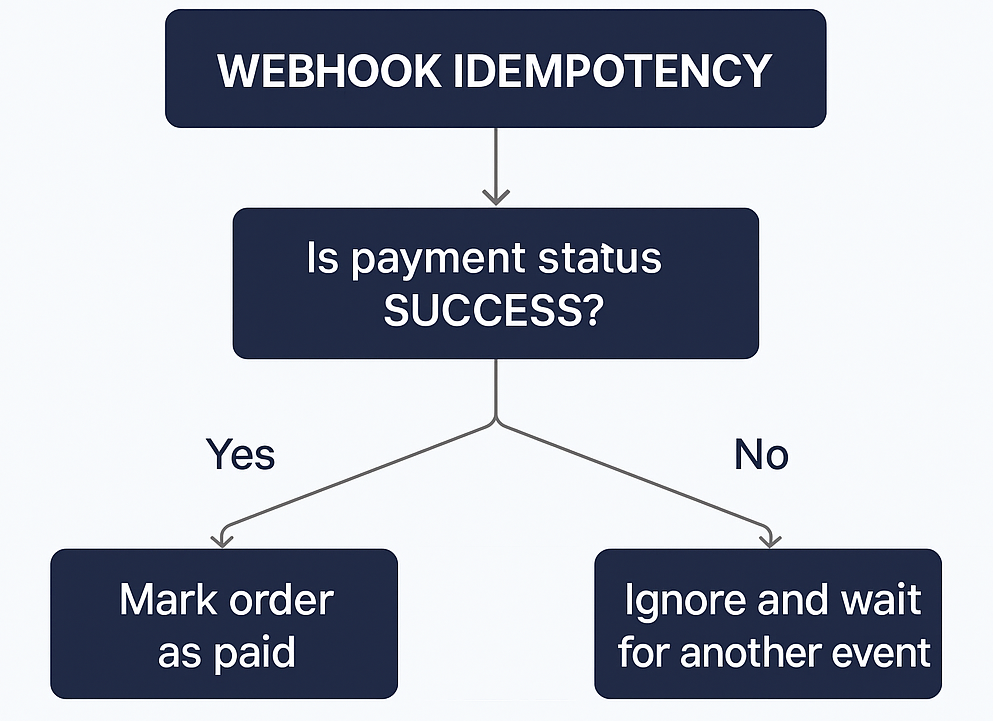
* **Terminal status**: Only consider webhook events where `payment_status = SUCCESS` as the final confirmation of payment for an order.
Statuses such as `FAILED`, `NOT_ATTEMPTED`, or `PENDING` are transitional and should not be treated as final.
 ## Best practices
The following are the recommended best practices:
* **De-duplicate using cf\_payment\_id**: Track `cf_payment_id` in your database and process each payment only once, regardless of how many webhook retries you receive.
* **Order-level validation**: Update the order status **only when** you receive a webhook that meets **all** of the following conditions:
* The `order_id` matches the one you created.
* The `payment_status` is `SUCCESS`.
* The order has **not already** been marked as paid.
* **Handle retried payments**: Users may retry failed payments. As a result, you may receive multiple webhook events in the sequence: `FAILED → PENDING → SUCCESS`.\
Implement logic to update the order status only upon receiving the `SUCCESS` webhook.
* **Ignore duplicate FAILED webhooks**: Webhook events with a `FAILED` status may be sent multiple times. Do not trigger any final actions for these statuses unless you are tracking them for logging or metrics.
* **Store payment attempts**: Keep a log of all `cf_payment_id` for a given `order_id` to support reporting, reconciliation, or dispute management.
* **Use HTTPS endpoints**: Your webhook URL must be publicly reachable from Cashfree. Production endpoints must use HTTPS.
* **Respond immediately**: Your endpoint must return a successful HTTP 200 response immediately after receiving the webhook payload.
* **Verify signatures**: Verify the webhook signature using the `x-webhook-signature` header before processing the payload to authenticate the request. For implementation details, see [Webhook signature verification](/docs/payments/online/webhooks/signature-verification).
Do not mark the order as PAID on receiving `FAILED` or `PENDING` statuses.
Always wait for a `SUCCESS` webhook before finalising the payment status.
## Webhooks as the source of truth
Cashfree webhooks provide server-to-server communication. This means your server receives the payment status even if the customer closes the browser or application before being redirected back to your site. Webhooks are the recommended source of truth for your internal systems. You can monitor webhook delivery and retry history in the **Logs** section. See [Webhook configuration](/docs/payments/online/webhooks/configure).
## Best practices
The following are the recommended best practices:
* **De-duplicate using cf\_payment\_id**: Track `cf_payment_id` in your database and process each payment only once, regardless of how many webhook retries you receive.
* **Order-level validation**: Update the order status **only when** you receive a webhook that meets **all** of the following conditions:
* The `order_id` matches the one you created.
* The `payment_status` is `SUCCESS`.
* The order has **not already** been marked as paid.
* **Handle retried payments**: Users may retry failed payments. As a result, you may receive multiple webhook events in the sequence: `FAILED → PENDING → SUCCESS`.\
Implement logic to update the order status only upon receiving the `SUCCESS` webhook.
* **Ignore duplicate FAILED webhooks**: Webhook events with a `FAILED` status may be sent multiple times. Do not trigger any final actions for these statuses unless you are tracking them for logging or metrics.
* **Store payment attempts**: Keep a log of all `cf_payment_id` for a given `order_id` to support reporting, reconciliation, or dispute management.
* **Use HTTPS endpoints**: Your webhook URL must be publicly reachable from Cashfree. Production endpoints must use HTTPS.
* **Respond immediately**: Your endpoint must return a successful HTTP 200 response immediately after receiving the webhook payload.
* **Verify signatures**: Verify the webhook signature using the `x-webhook-signature` header before processing the payload to authenticate the request. For implementation details, see [Webhook signature verification](/docs/payments/online/webhooks/signature-verification).
Do not mark the order as PAID on receiving `FAILED` or `PENDING` statuses.
Always wait for a `SUCCESS` webhook before finalising the payment status.
## Webhooks as the source of truth
Cashfree webhooks provide server-to-server communication. This means your server receives the payment status even if the customer closes the browser or application before being redirected back to your site. Webhooks are the recommended source of truth for your internal systems. You can monitor webhook delivery and retry history in the **Logs** section. See [Webhook configuration](/docs/payments/online/webhooks/configure).