Why choose smart rules
Smart Rules offer the following benefits:- Comprehensive coverage: Over 30 risk parameters are evaluated in real time across devices, locations, identities, payments, and user behaviours to support advanced fraud detection strategies.
- Flexible logic engine: Supports advanced operators such as range-based filtering, multi-value matching, and nested AND/OR conditions, enabling precise and customisable rule creation.
- Business-friendly interface: Provides a visual rule builder with plain-language explanations and a pre-built rule library, enabling quick deployment without technical expertise.
- Adaptive risk management: Rules can be updated and refined in real time based on emerging fraud patterns, ensuring continuous protection without disrupting legitimate transactions.
- Scalability: Handles high transaction volumes without performance degradation, making it suitable for fast-growing or high-risk businesses.
Use cases
You can apply Smart Rules to the following scenarios for threat protection:Smart rule logic and configuration parameters
Smart Rules are built using a simple When–Then logic structure, where conditions are defined under When and corresponding actions are executed under Then. There are two types of Smart Rules:Conditional rules
These rules are executed in real time, based on specific conditions and fixed parameters. Example 1: If the transaction amount is ≥ ₹50,000 AND the proxy type is VPN AND the city is Jamtara, then block further transactions.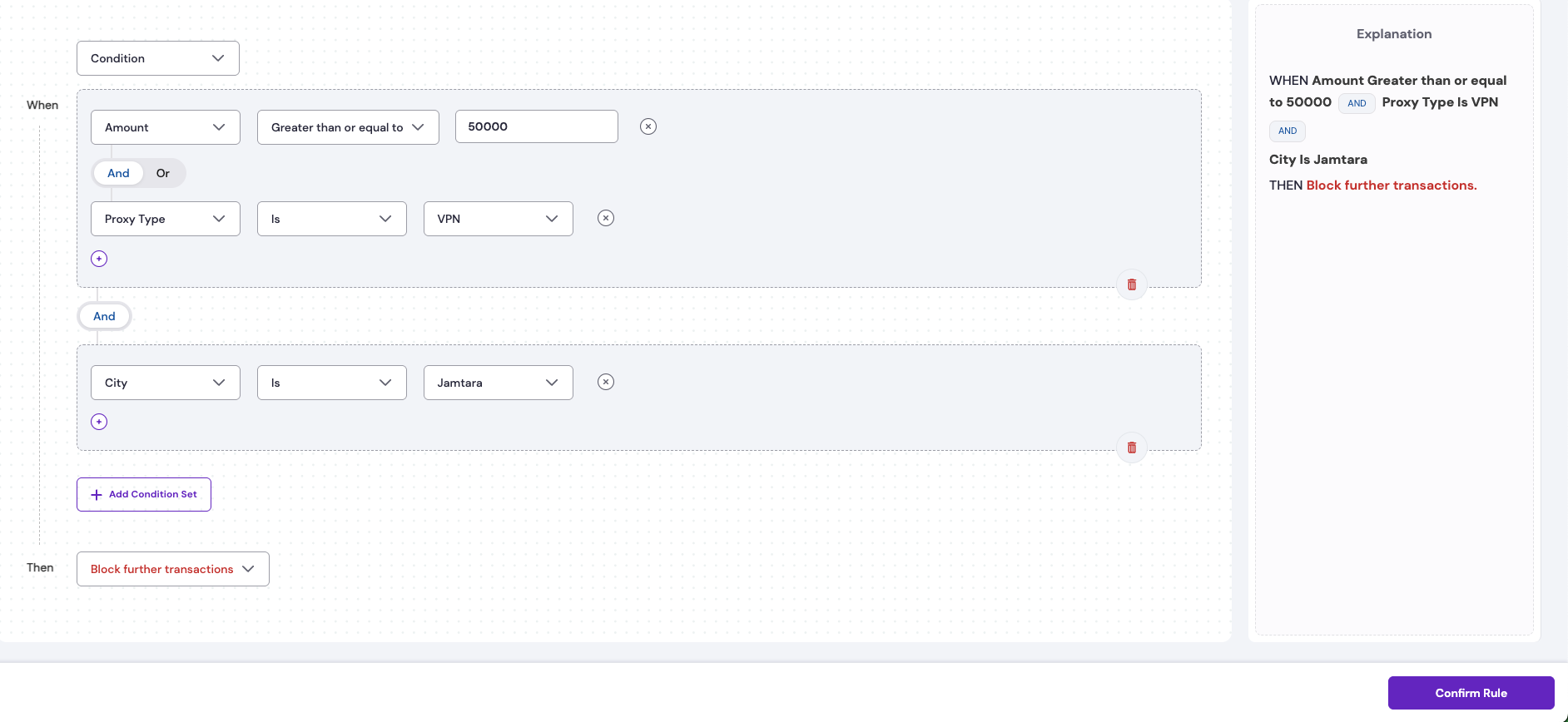
Blocking high-value transaction from high-risk location
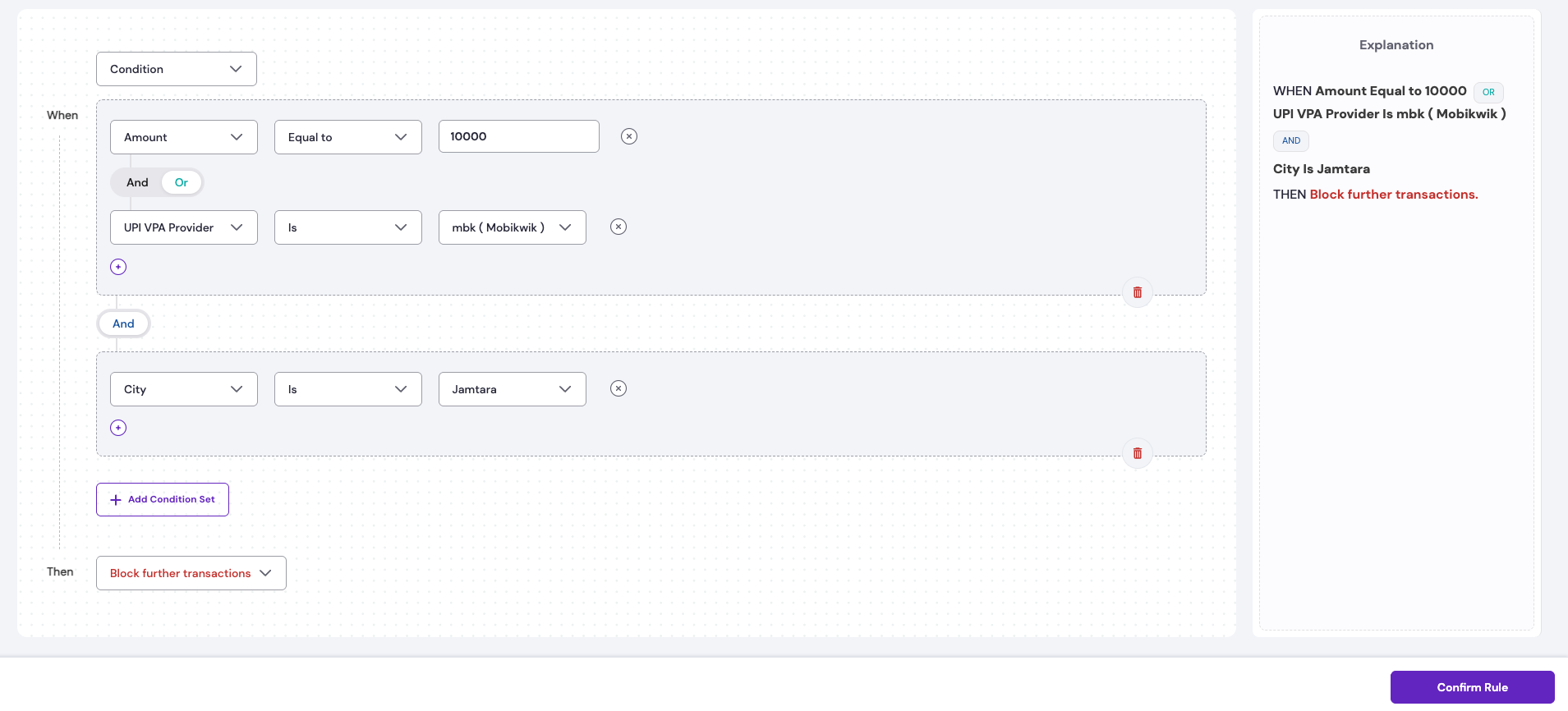
Block high-value transactions from high-risk locations when Mobikwik is used
Conditional rule explanation
The above rule is designed to block transactions when specific high-risk conditions are met. WHEN- Amount = 10,000
- UPI VPA Provider = Mobikwik
- City = Jamtara
- Block further transactions.
- The user will be unable to complete this transaction or any other transaction that meets these conditions.
- No debit occurs from the user’s account.
Aggregate rules
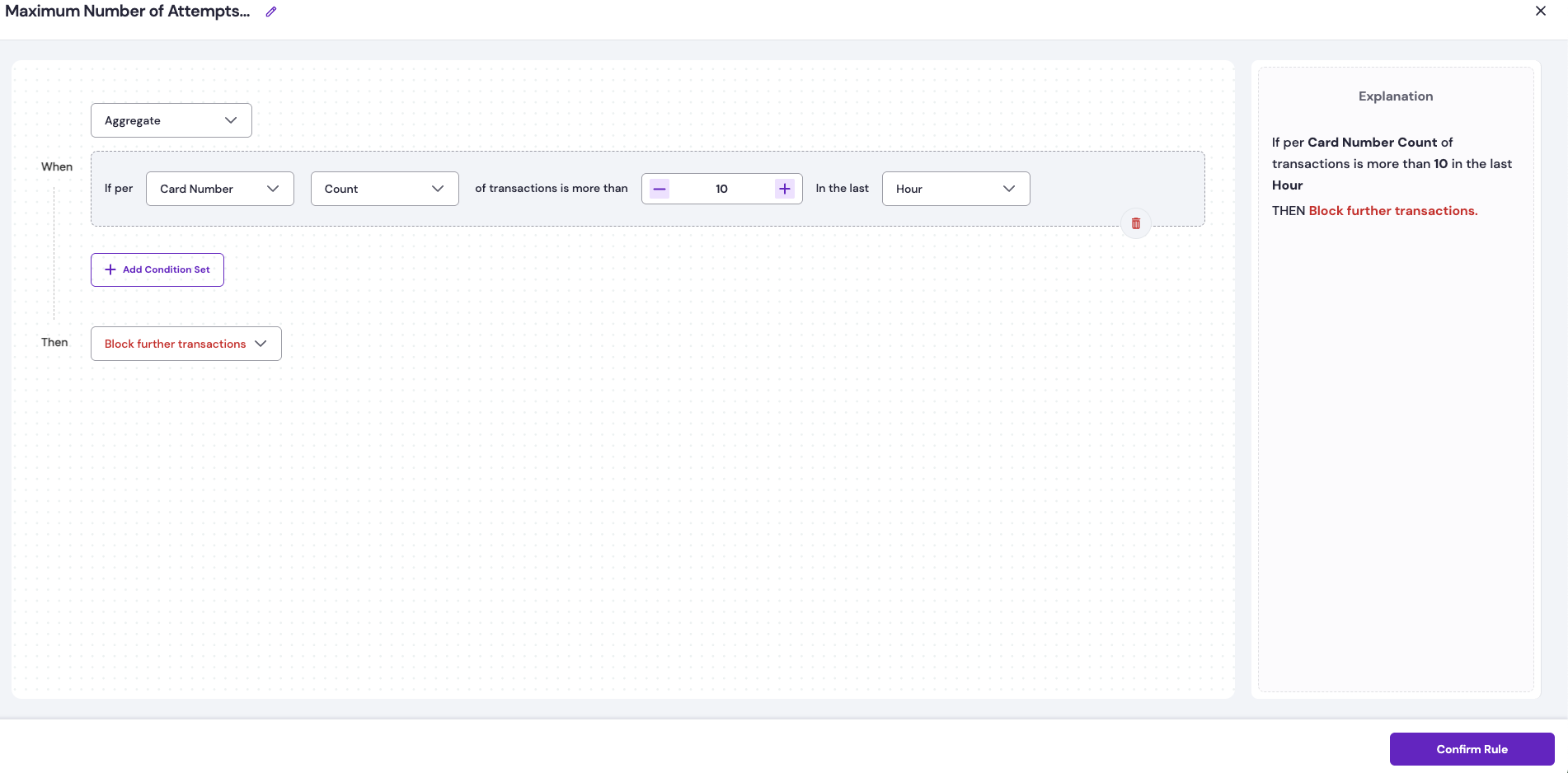
These are aggregated rules that consider a user’s past transactions before triggering actions. They combine velocity checks with multiple conditions to create optimised, comprehensive rules. Example 1: Limit the total successful transaction amount to ₹25,000 per card per hour.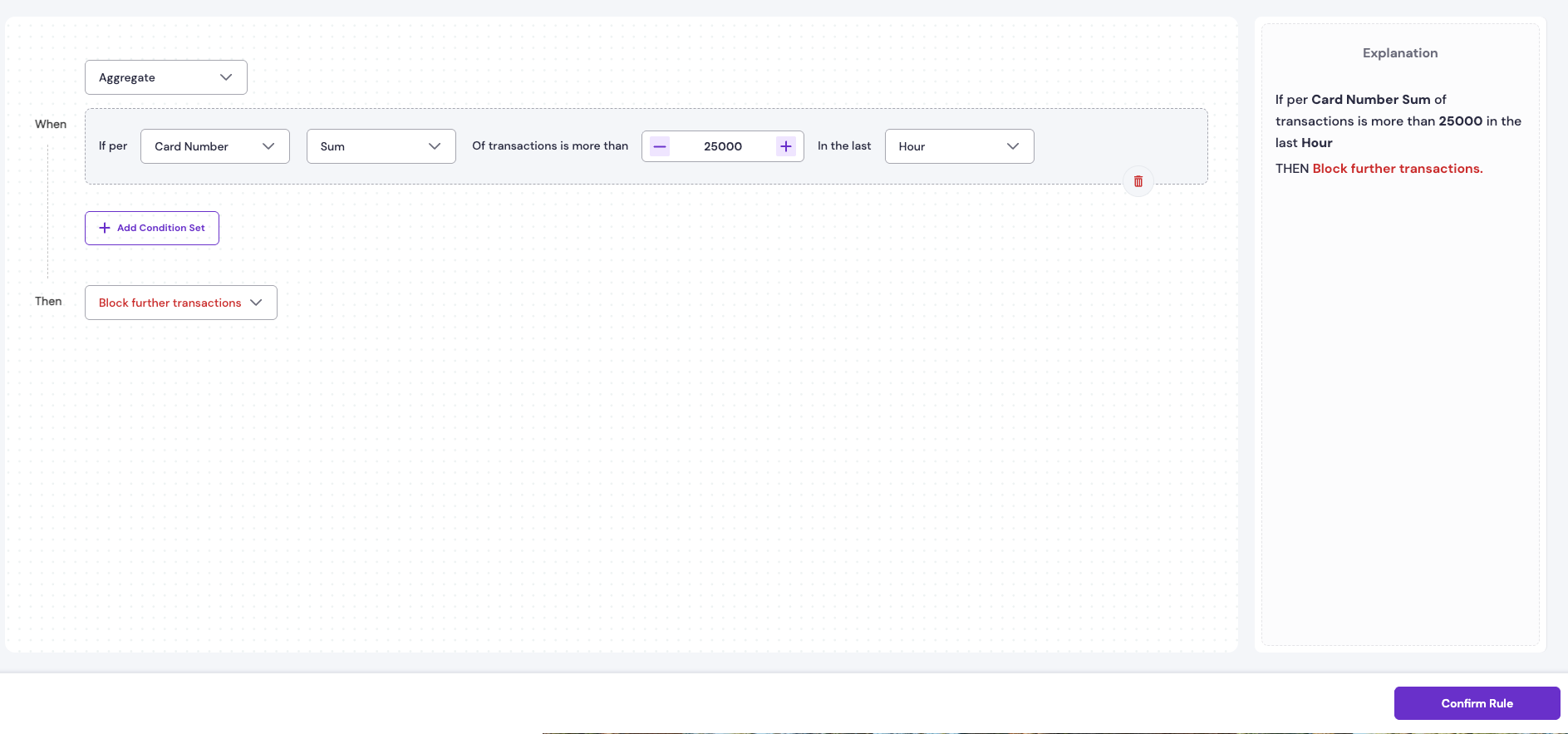
Limiting transaction amount per card
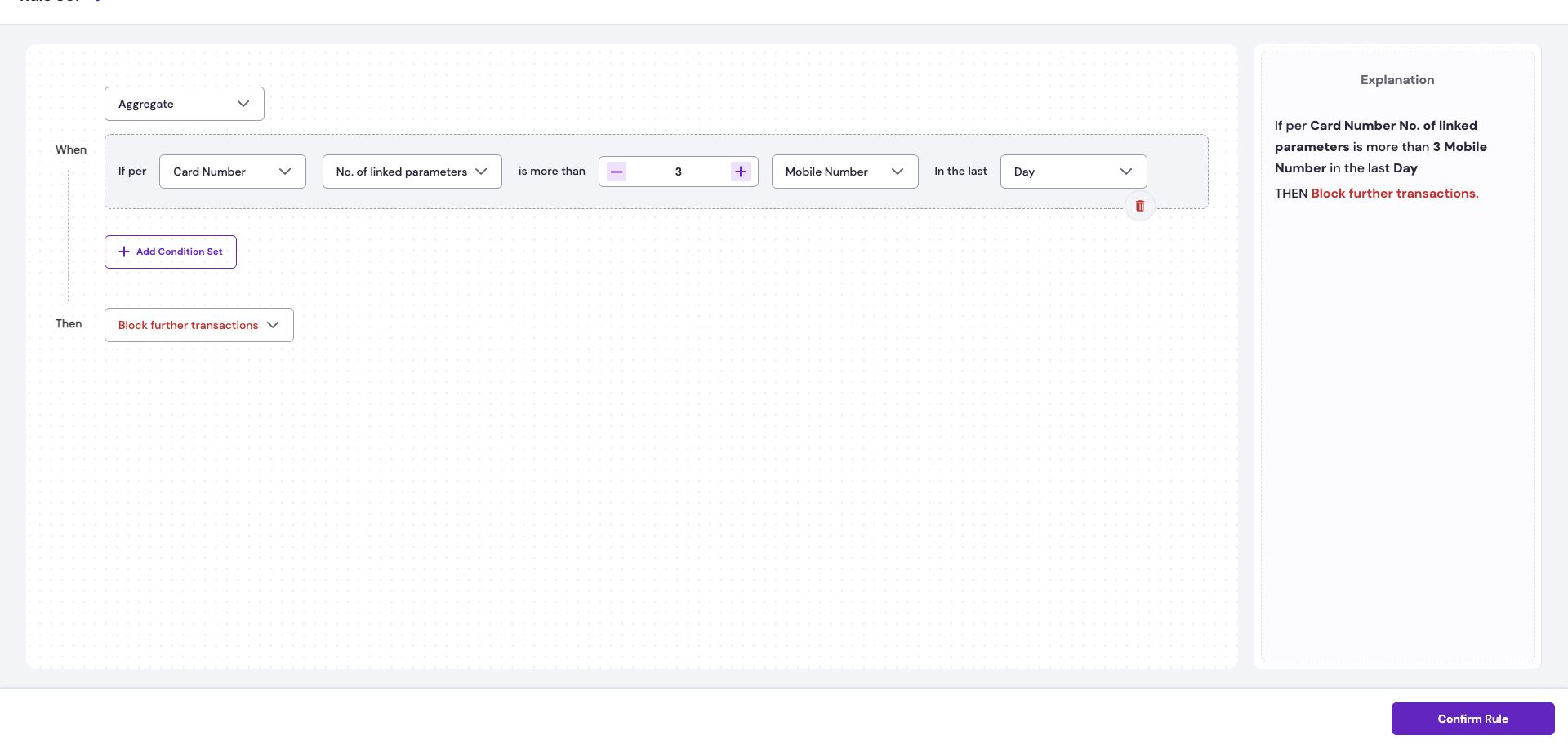
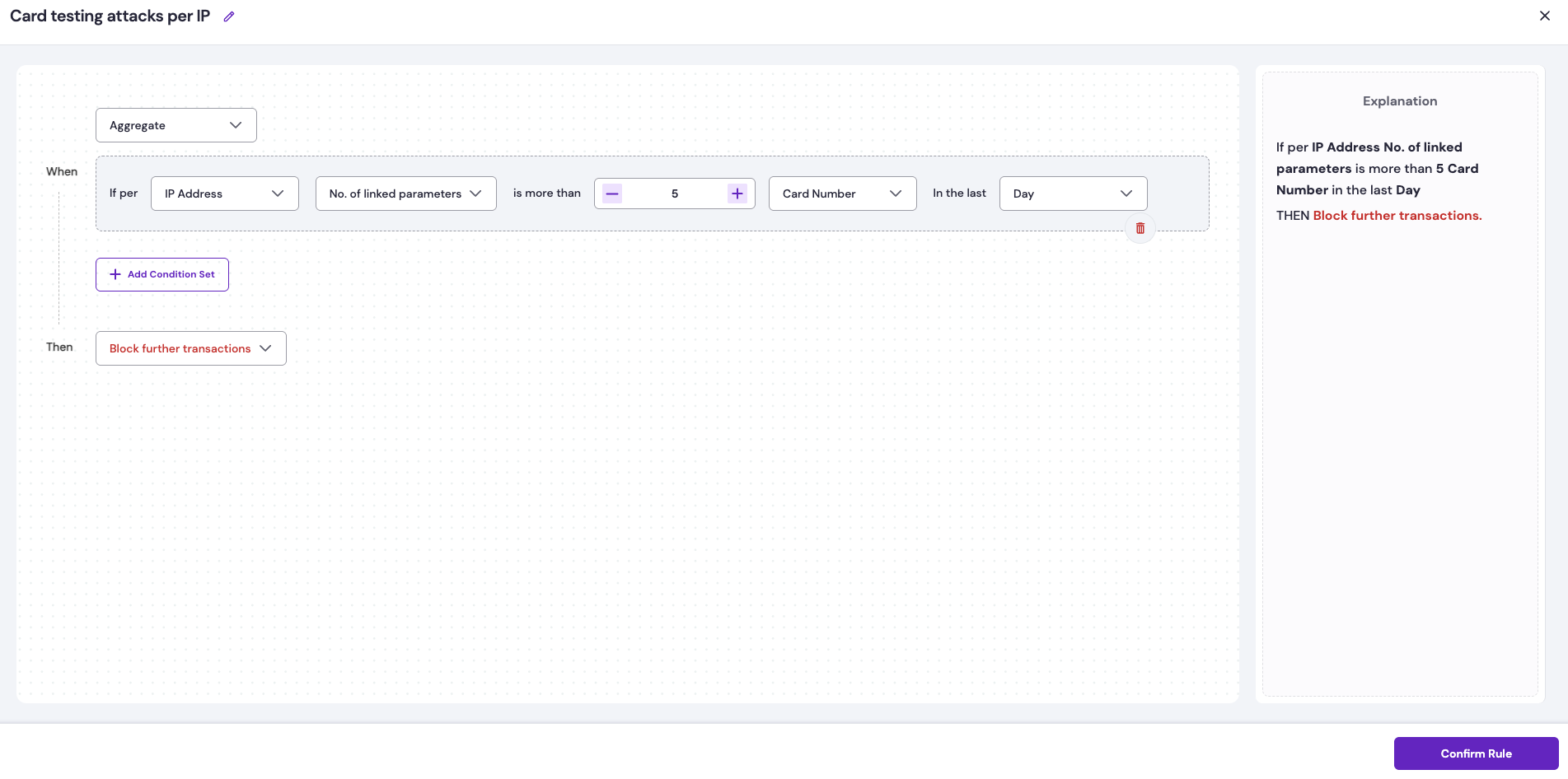
Block card sharing among users
Aggregate rule explanation
The above rule is designed to prevent card sharing among users by preventing more than three mobile numbers from being linked to the same card for payment in a given day. WHEN- For each Card Number, the Number of linked parameters i.e Mobile Number is more than 3 within the last Day.
- Block further transactions.
- Prevents linking a fourth or additional mobile number to the same card for payments in that time period.
By default, all rules follow the logic of successful transactions.
For example, if the rule is Do not allow more than ₹25,000 per card per day, it is interpreted as applying only to successful transactions. In other words, the rule prevents more than ₹25,000 in total successful GMV per card per day.
Rule outcomes
The two Smart Rule outcomes are:- Block further transactions: Prevents any new transactions from being processed. Users will not be able to complete a transaction, and no debit will occur. In UPI Intent cases, a debit may still happen but is immediately refunded. All such attempts are marked as FAILED in Cashfree’s system.
- Flag further transactions: The transaction is processed like any regular transaction, and the merchant receives settlement as usual. However, the transaction is highlighted in the Risky Transactions section of RiskShield for monitoring and review.
Smart rule parameters
Smart Rules evaluate transactions using the following parameter types to identify and prevent potential fraud attempts:Conditional rule parameters
The following table lists the parameters available for creating conditional rules:Aggregate rule parameters
The following tables lists the parameters available for creating aggregate rules:Aggregation setup parameters
Filter criteria parameters
Create a smart rule
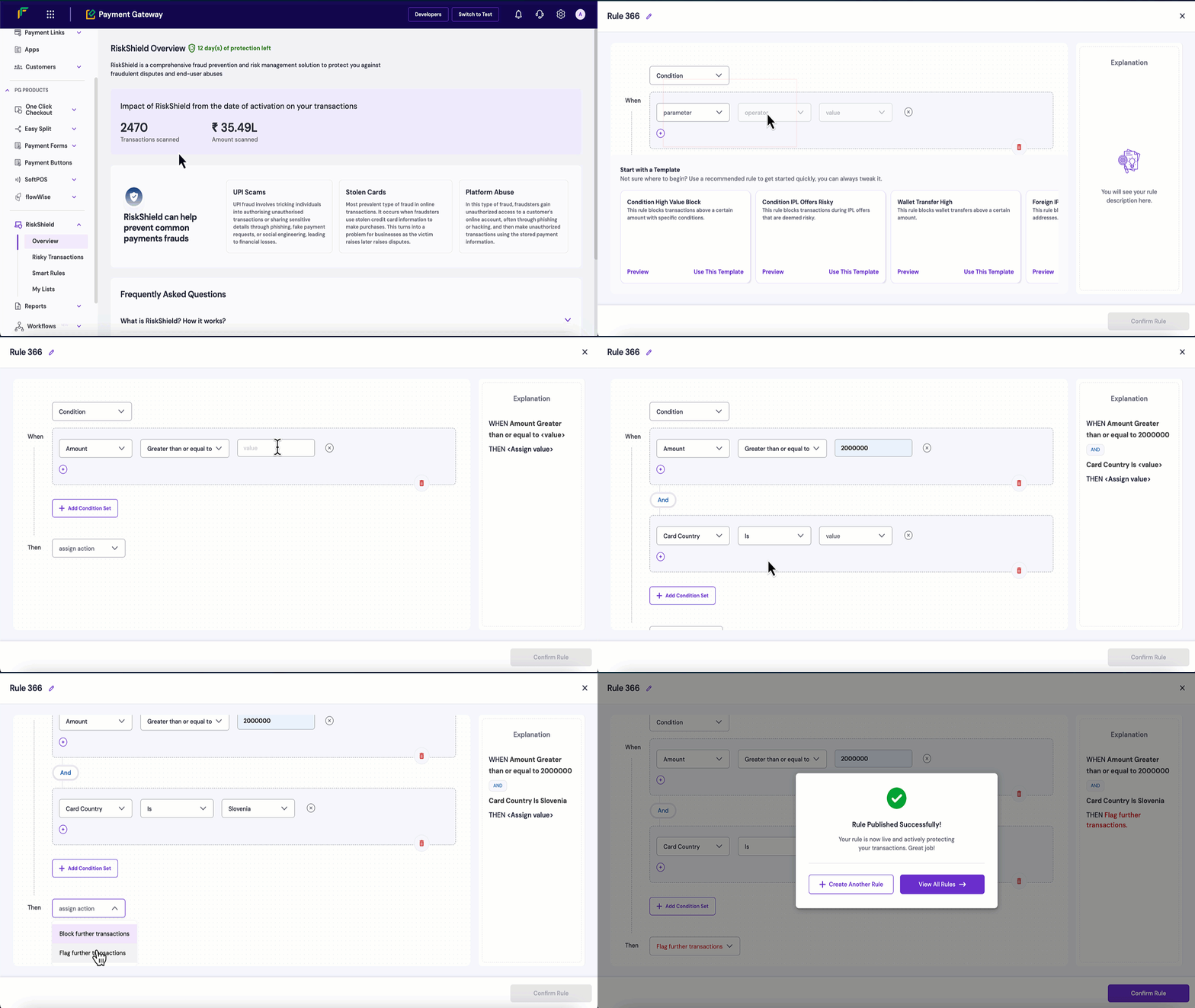
Follow these steps to build a Smart Rule based on transaction criteria:- Log in to the Merchant Dashboard.
- Navigate to RiskShield > Smart Rules.
- Click Create Smart Rule.
- Enter a descriptive Rule Name.
- Configure the When conditions:
- Select the type of filtering from the dropdown menu, such as Condition or Aggregate based.
- Select the parameter used to evaluate transactions on.
- Select the specific operator based on the chosen parameter.
- Enter the comparison value(s).
- Click Add Condition Set for additional conditions with AND/OR logic.
- Configure the Then outcome: Block or Flag further transactions.
- Review the auto-generated rule Explanation in English for verification.
- Click Confirm Rule to create the new rule.
Managing existing smart rules
Once created, all configured Smart Rules appear in a comprehensive dashboard table under the Smart Rules section, providing complete visibility and control over your fraud prevention system.Rule dashboard overview
The Smart Rules dashboard displays three main categories:- All Rules: Complete list of all configured rules which includes activated and deactivated rules.
- Active Rules: Currently enabled and executing rules.
- Recommended: Pre-configured rules suggested by Cashfree for fraud prevention use.
- Active: The rule is currently enabled and actively monitoring transactions.
- Inactive: The rule is disabled and not monitoring transactions.
- Recommended: The rule is suggested by Cashfree based on transaction patterns and risk factors.
Scenario examples
The following examples show practical Smart Rule configurations with real-world scenarios. Each example illustrates the conditions, actions, and outcomes to guide effective fraud-prevention strategy setup.Conditional rule-based scenarios
The following scenarios illustrate common situations where conditional rule-based filtering enhances fraud detection and transaction control.- VPN transactions
- Credit card limits
- High-risk cities
- High-risk countries
Scenario: High-value transaction from VPN.
Objective: Detect and block transactions over 50,000 initiated from VPN connections to mitigate fraud risk.
Rule configuration: Amount >= 50,000 and Proxy Type Is = VPN.\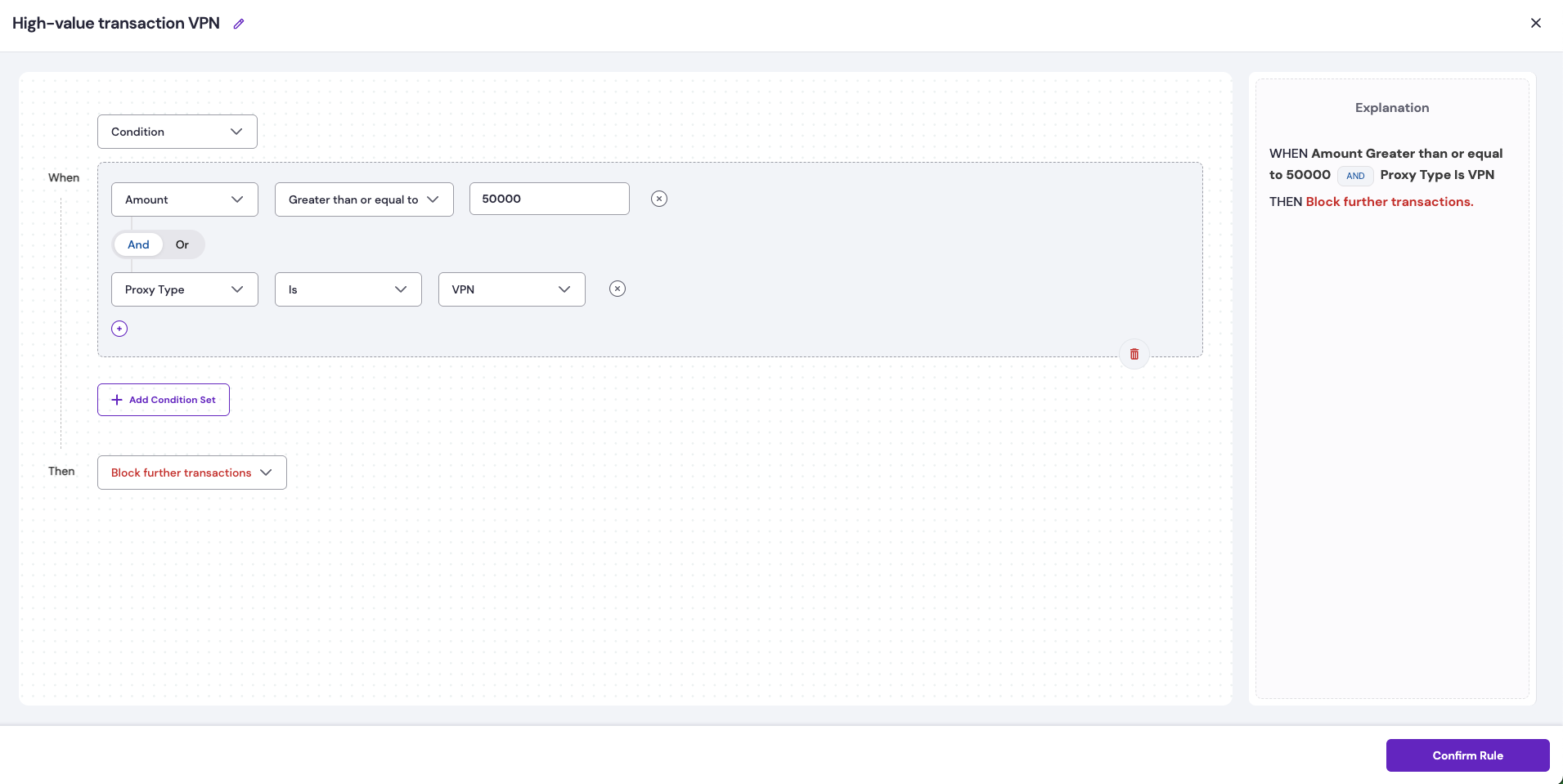
Objective: Detect and block transactions over 50,000 initiated from VPN connections to mitigate fraud risk.
Rule configuration: Amount >= 50,000 and Proxy Type Is = VPN.\
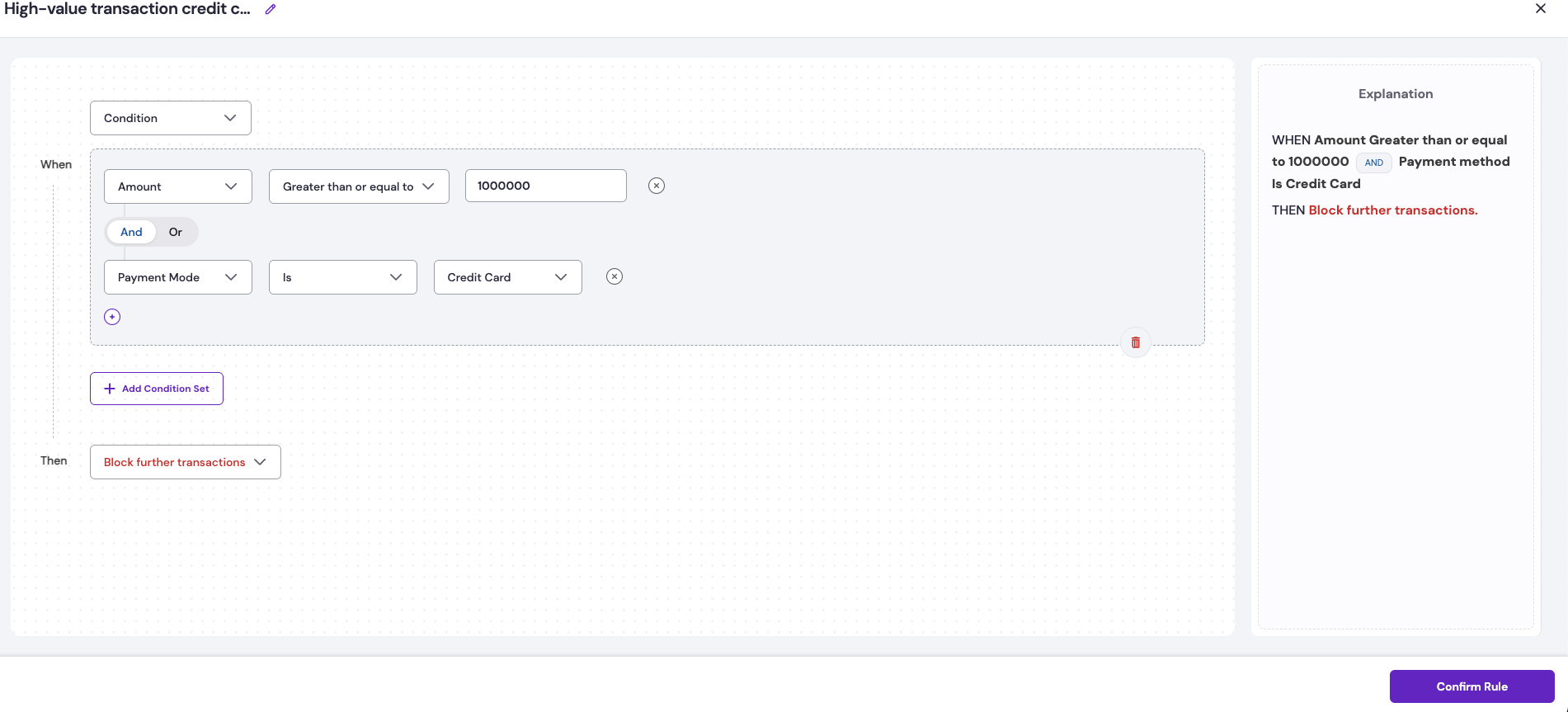
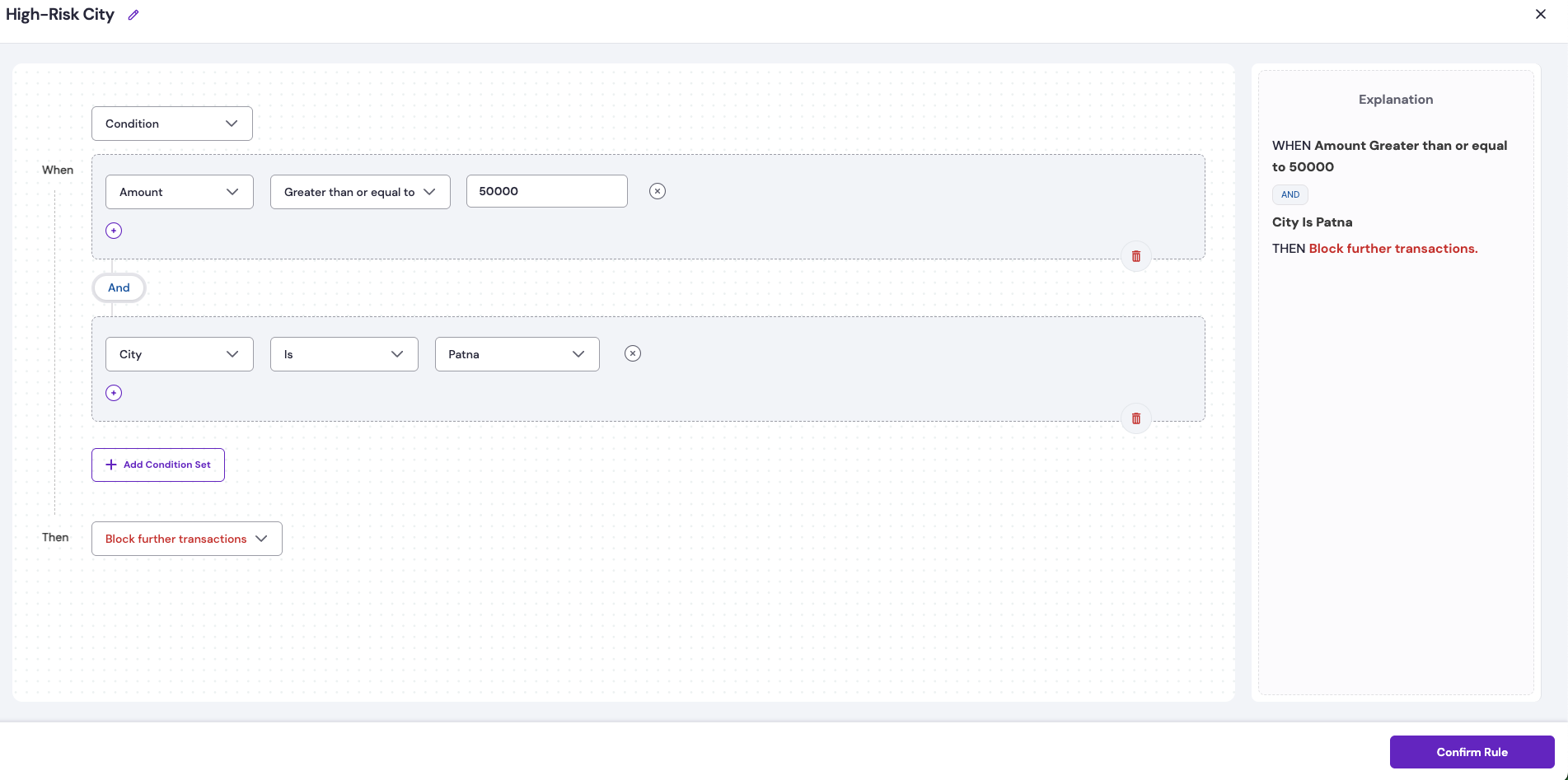
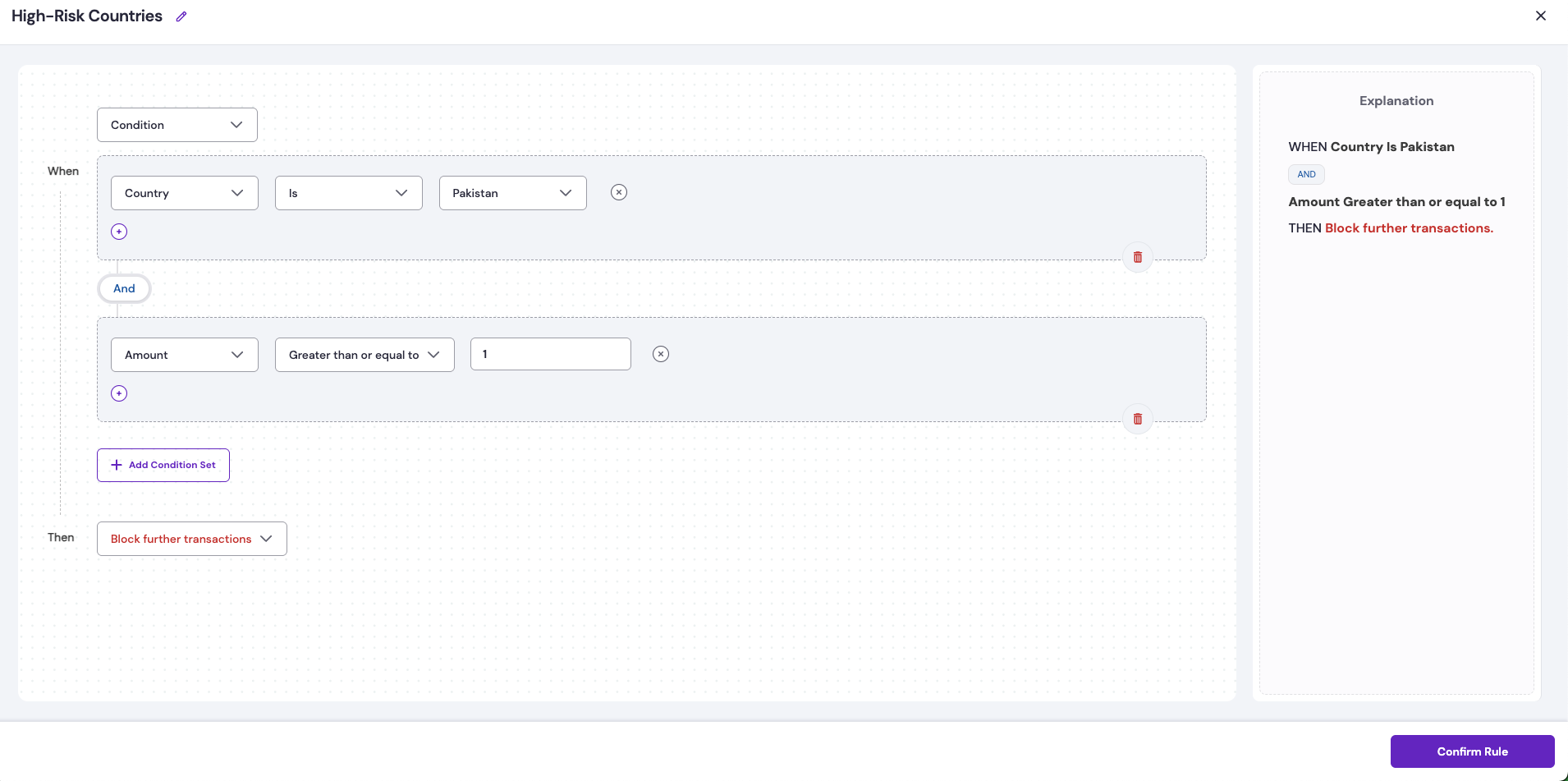
Aggregated rule-based scenarios
The following scenarios highlight common use cases where aggregate rule-based monitoring helps detect abnormal patterns and prevent fraudulent activity.- Mobile frequency
- Card attempts
- Card testing
- Card sharing
Scenario: Multiple successful transactions per mobile in short interval.
Objective: Block cases where a single mobile number completes more than three successful transactions within five minutes to prevent rapid fraud attempts.
Rule configuration: Base parameter = Mobile Number, aggregation type = Count, duration = 5 minutes, condition = Count > 3.\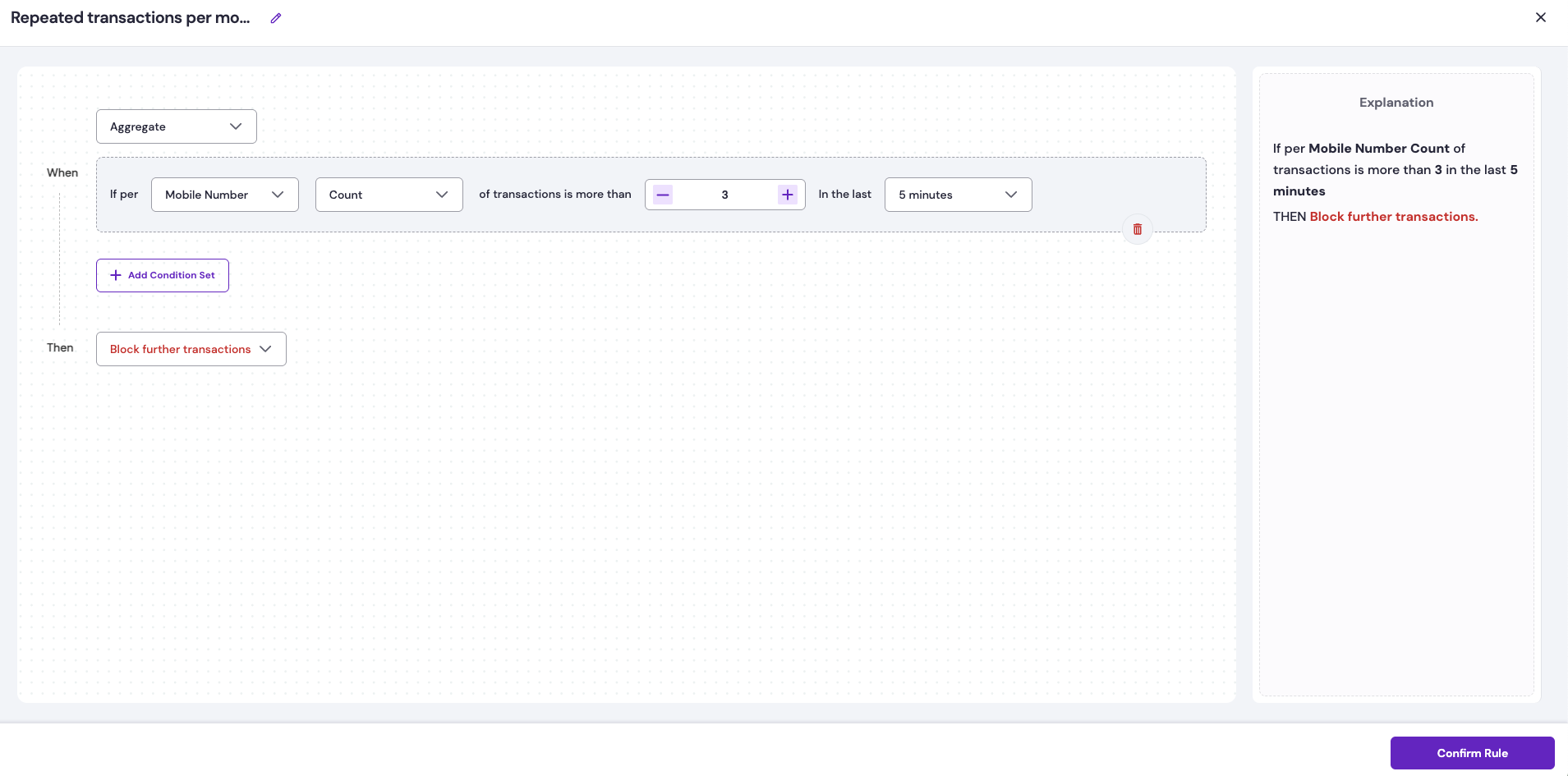
Objective: Block cases where a single mobile number completes more than three successful transactions within five minutes to prevent rapid fraud attempts.
Rule configuration: Base parameter = Mobile Number, aggregation type = Count, duration = 5 minutes, condition = Count > 3.\