

Documentation Index
Fetch the complete documentation index at: https://www.cashfree.com/docs/llms.txt
Use this file to discover all available pages before exploring further.
Can I receive payments from my customers without integrating Cashfree to my website?
Can I receive payments from my customers without integrating Cashfree to my website?
Can I create a payment link for a restricted time period?
Can I create a payment link for a restricted time period?
I run an NGO. How can I use Cashfree to accept donations?
I run an NGO. How can I use Cashfree to accept donations?
- Go to PG Dashboard > PayMe > Add PayMe Link.
-
Enter a PayMe Identifier and PayMe Description:
-
PayME Identifier: The URL identifier after
https://www.cashfree.com/donation/{identifier}which will be shared with customers. (Example: covid-relief-fund). - PayME Description: Title of the campaign. (Example: India Needs Oxygen and Vaccines!).
-
PayME Identifier: The URL identifier after
- Enter the phone number on which you want to be notified when your customers make the payments. You can also add a secondary phone number.
- Select Create A PayMe Link.
- Go to PG Dashboard > PayMe > PayMe Details.
- Select ADD FORM or EDIT FORM.
-
In the subsequent form edit screen, add the following fields:
-
Small Input for Donor PAN (if you want to collect donor PAN details):
- Field Label: Donor PAN.
- Field Options: Required (enable if you want to keep PAN mandatory).

-
Large Input for Donor Residential Address (if you want to collect donor address details):
- Field Label: Residential Address.
- Field Options: Required (enable if you want to make the address mandatory).
- Use multiple Section Breaks to add the static text content to show beside the form.
-
Small Input for Donor PAN (if you want to collect donor PAN details):
- Field Label is shown as a section title on the website (Example: Contact Us).
- Field Description is shown as section text content on the website.
- To add new lines in the Field Description text, use <br> in the text, and the content after that will be in a new line. Do not use the Enter key for this purpose (Example: the text “xyz@example.com<br>+9199999xxxxx<br>Address” will be shown as follows, with content after <br> shown in a new line).
-
You can use the following content (one section break for each section) as a reference to create a complete donation page:
-
Donation Cause:
- Mention how the donated funds will help Covid-19 patients and if you have partnered with any other donation agency.
- Example: Our hospitals are going through dire situations, we urgently need more oxygen cylinders, concentrators and vaccine doses to save as many lives as possible. <br>This campaign started as a self-funded mission to help hospitals across the country get immediate access to 100 oxygen concentrators and fund 5000 vaccine doses.
-
Tax Exemption Details:
- If your organisation is eligible to give 80G certificates, clearly mention your registration number and PAN details.
- Example: Your contribution has an exemption of 50% under Section 80G of the IT Act. An 80G certificate will be provided within a few days if a valid PAN and residential address are provided by the payer. Compulsory for donations above Rs. 50,000. <br>Registration No: XX <br>PAN: XX.
-
Contact Us:
- Provide your valid contact details so donors can reach out to you.
- Example: youremailid@yourdomain.com<br>+9199999xxxxx<br>Your Registered Address.
-
Terms & Conditions:
- Mention any terms and conditions if applicable to donors.
- Example: Donations using this link can be made by Indian citizens only (residents and non-residents). We accept cards issued outside India.
-
Donation Cause:
- Select Save Form to save the changes.
-
You can check the link on
https://www.cashfree.com/donation/{identifier}. This is different from the usual PayMe address -https://cashfree.com/payme/{identifier}. - If you follow all the above-mentioned steps correctly, the final output would be similar to the image below:
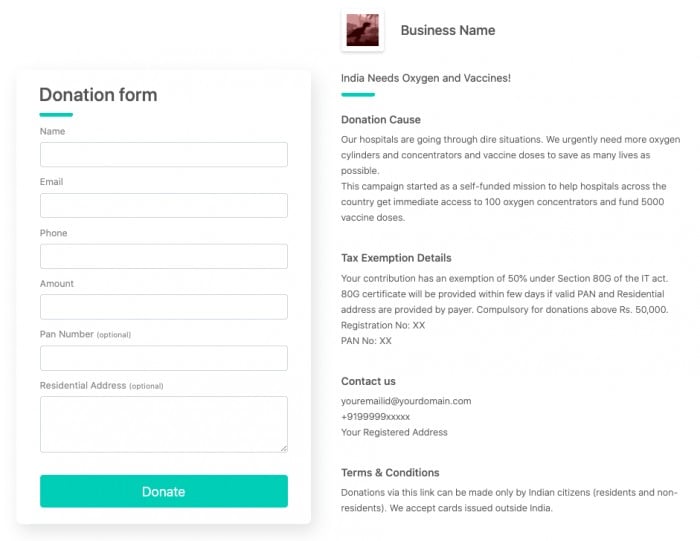 Now, go ahead and start collecting funds for a cause that’s dear to you!
I want to accept international payments. Can I use Cashfree to accept payments in other currencies?
I want to accept international payments. Can I use Cashfree to accept payments in other currencies?
Can I receive international payments via PayPal using Cashfree?
Can I receive international payments via PayPal using Cashfree?
I am an existing PayPal user. How do I connect my PayPal account with Cashfree?
I am an existing PayPal user. How do I connect my PayPal account with Cashfree?
When will the payment gateway charges be deducted for my transactions?
When will the payment gateway charges be deducted for my transactions?
How do I initiate refunds in Cashfree?
How do I initiate refunds in Cashfree?
Can I initiate bulk refunds in Cashfree?
Can I initiate bulk refunds in Cashfree?
How long does it take to process refunds?
How long does it take to process refunds?
- UPI: Up to 5 working days.
- Cards: Up to 7 working days.
- Net Banking and others: 7 to 10 working days.
What should I do before updating or displaying the status of a transaction or order to the customer?
What should I do before updating or displaying the status of a transaction or order to the customer?
- Check the status manually in the Merchant Dashboard.
- Use the return URL flow to confirm the final status.
- Handle redirection failures and delayed status changes with webhooks.
- Use the API to retrieve the latest status.